Research
The group works across molecular design, materials, devices, and systems, with research applications in energy, environment, and health.
Four themes, one research programme
The group's work spans molecular and materials design, sensing, energy devices, and environmental remediation. These are not separate efforts: the same understanding of molecular structure and charge transport that informs a conjugated polymer for a solar cell also informs a receptor for a chemical sensor. The sections below describe each theme; the full research narrative follows underneath.
Molecular & Electronic Materials
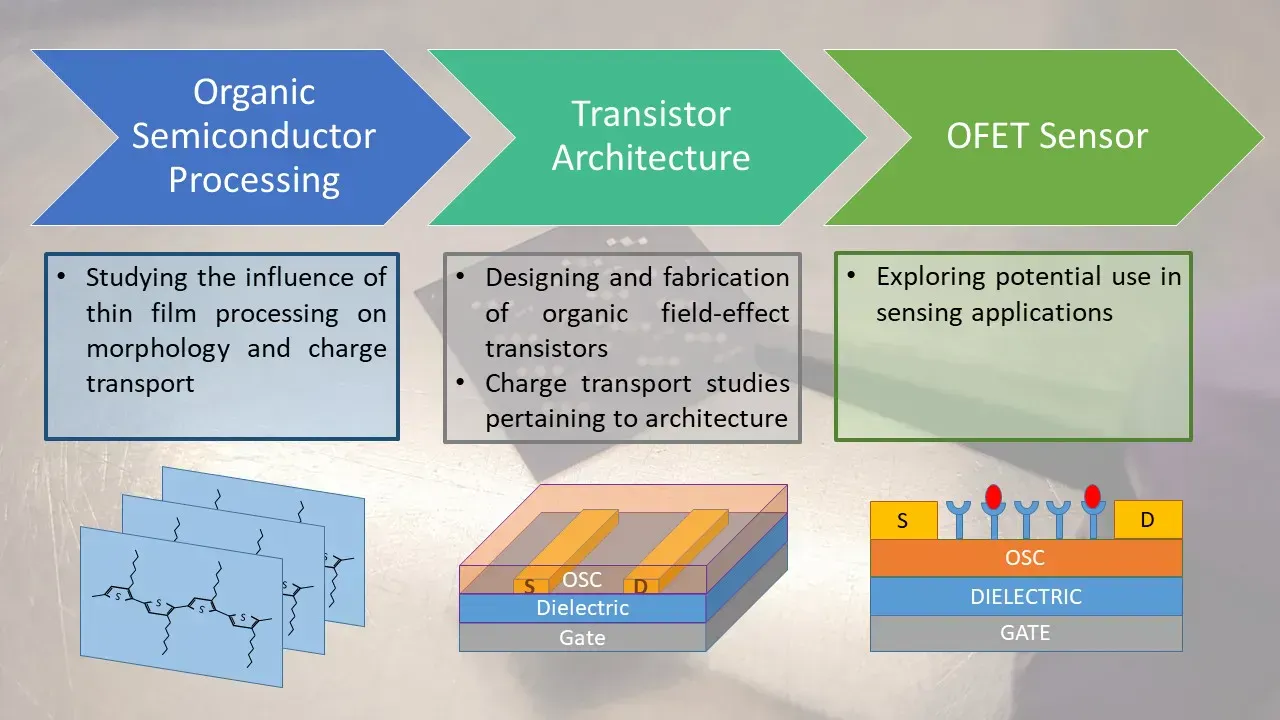
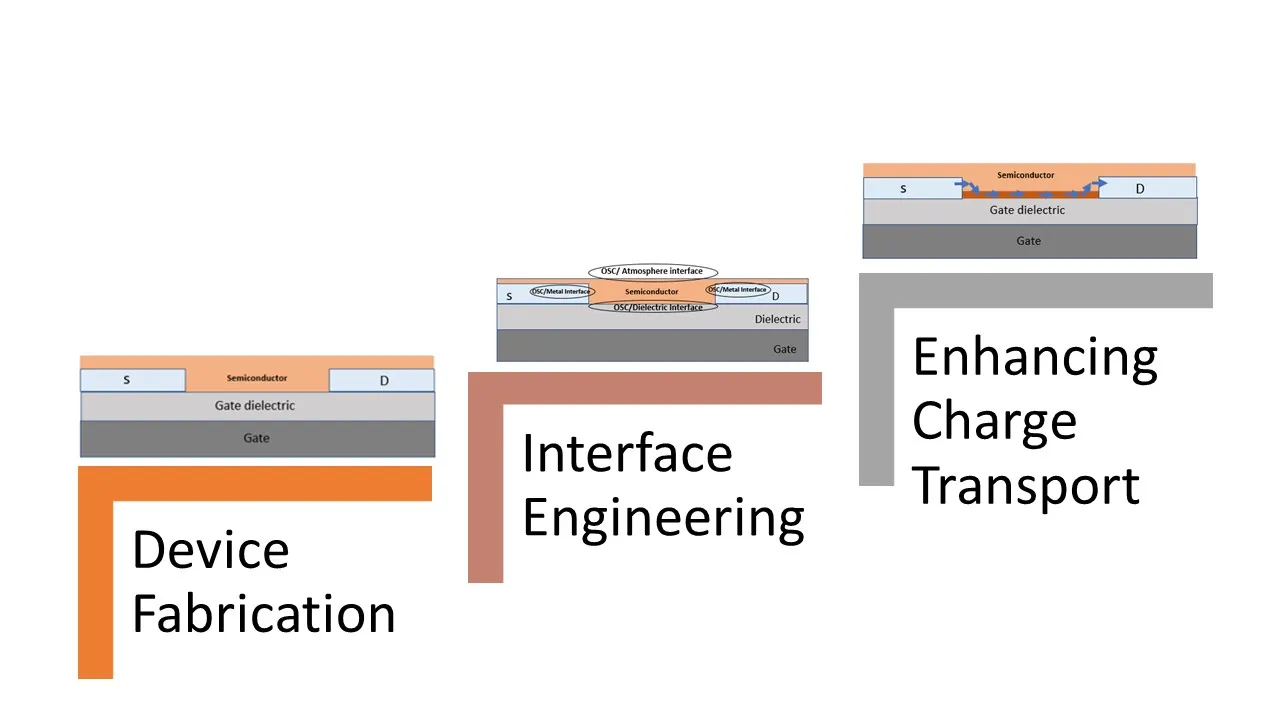
At the heart of this work is the rational design of bandgap-engineered molecules and conjugated polymers. The group studies electronic structure tuning in donor-acceptor frameworks and hybrid composites, charge transport dynamics including exciton diffusion, polaron motion, and trap-limited recombination, semiconductor-electrode interface engineering, and how nanoscale ordering correlates with macroscopic electronic behaviour.

Sensors & One Health
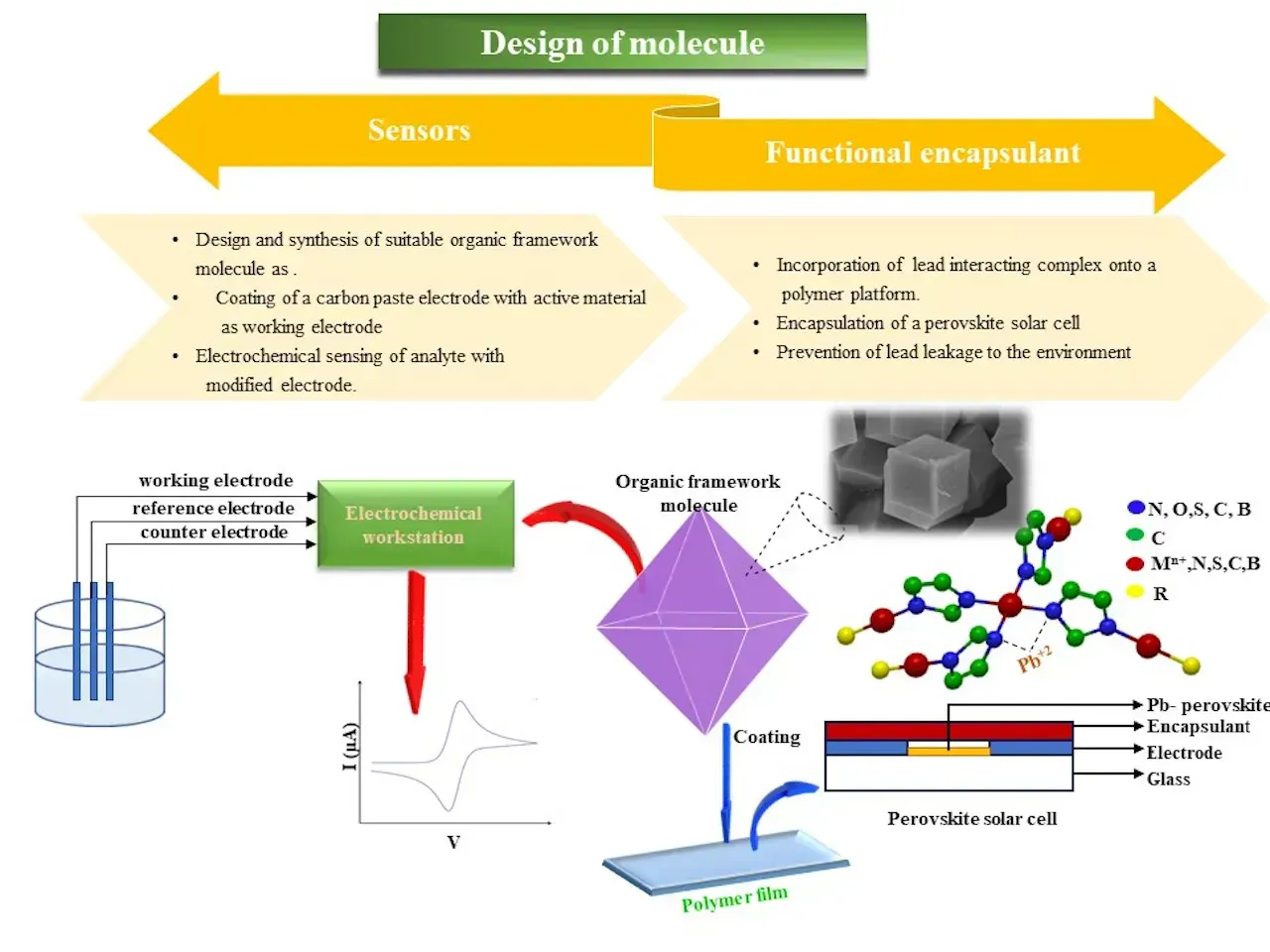
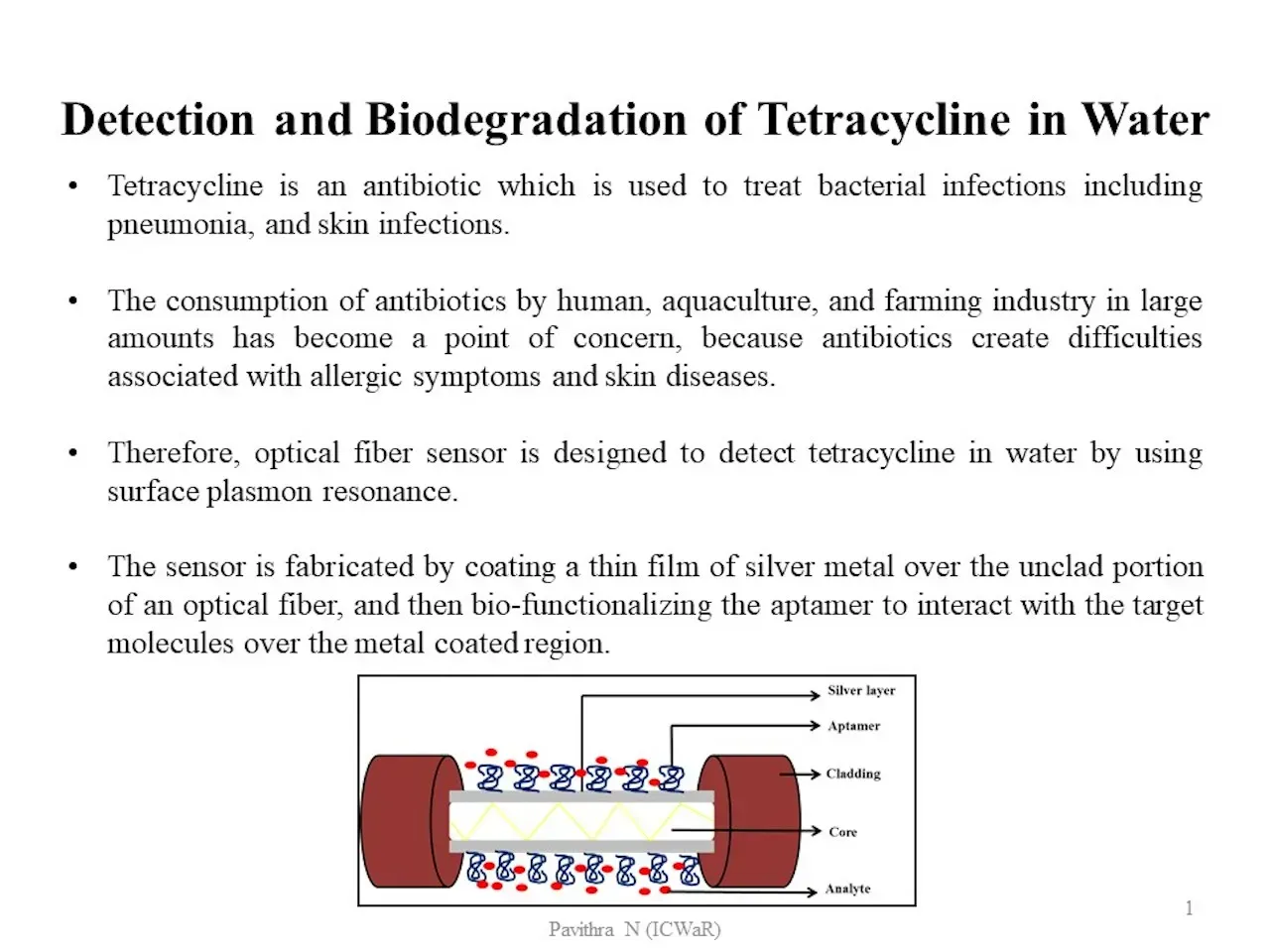
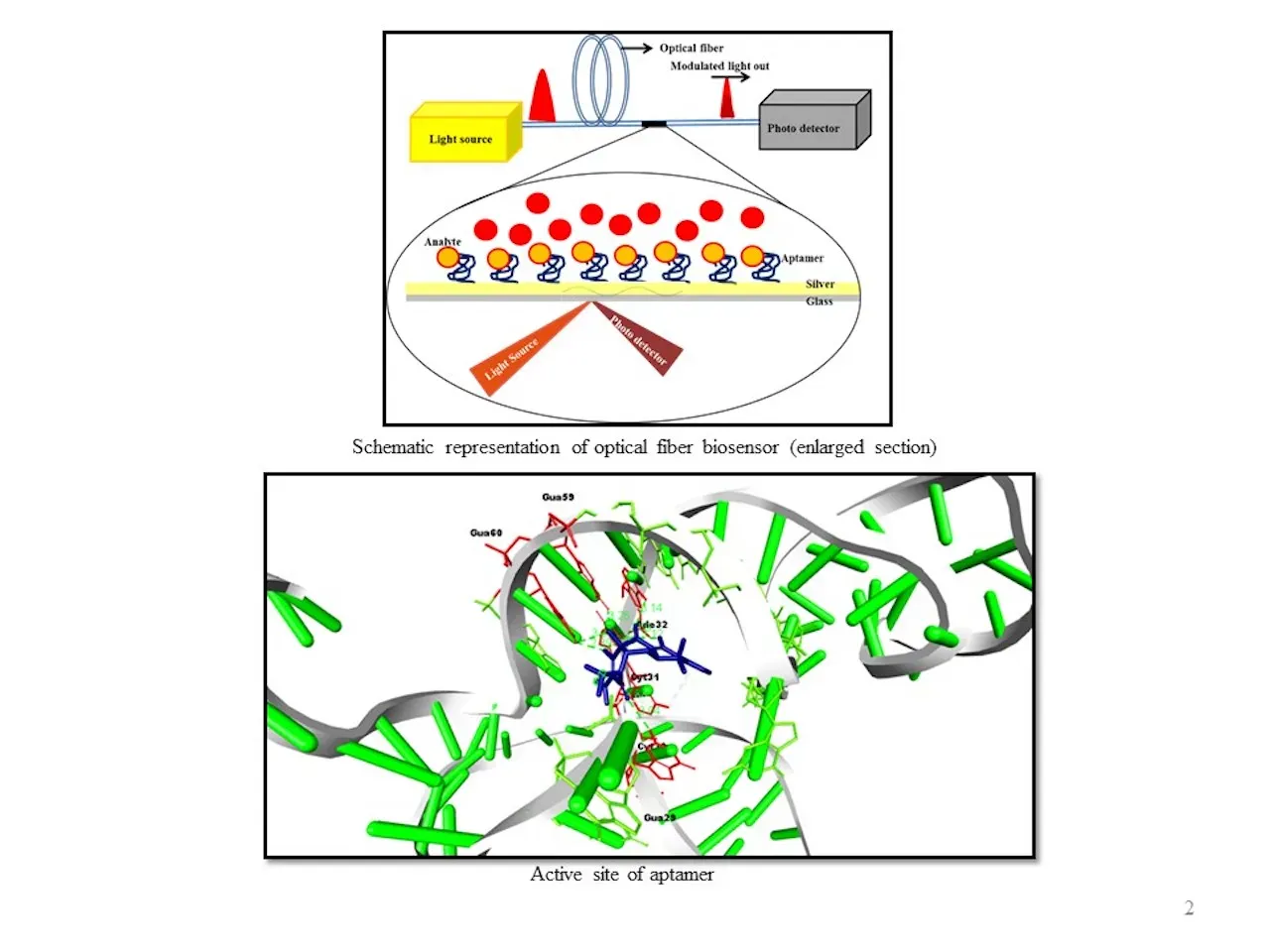
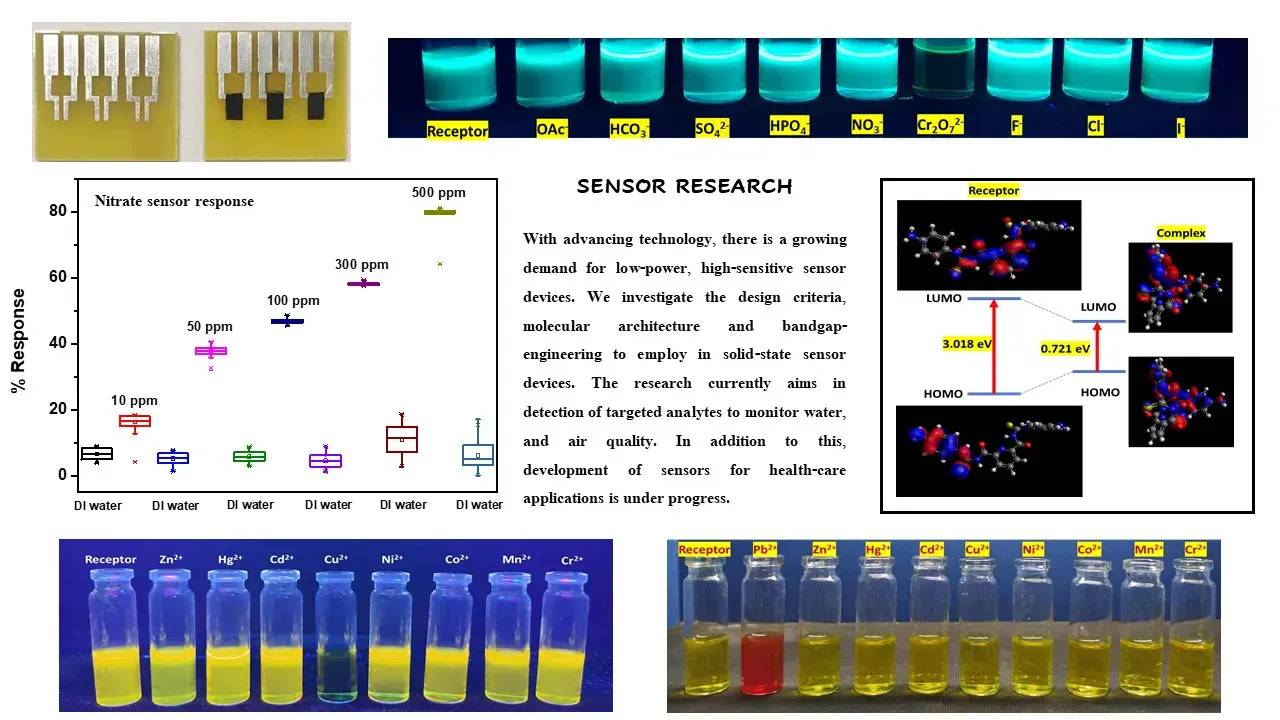
The group builds sensors that use molecularly engineered receptors and nanostructures to translate recognition events into measurable charge or optical signals. Aligned with the One Health paradigm, these sensors target VOCs, toxic ions such as arsenic, lead, mercury, cadmium, and chromium, biomarkers and pathogens, and emerging contaminants including pesticides, antibiotics, PFAS, and microplastics, with an emphasis on real-time, IoT-enabled monitoring of water, food, and air quality.

Energy & Device Engineering
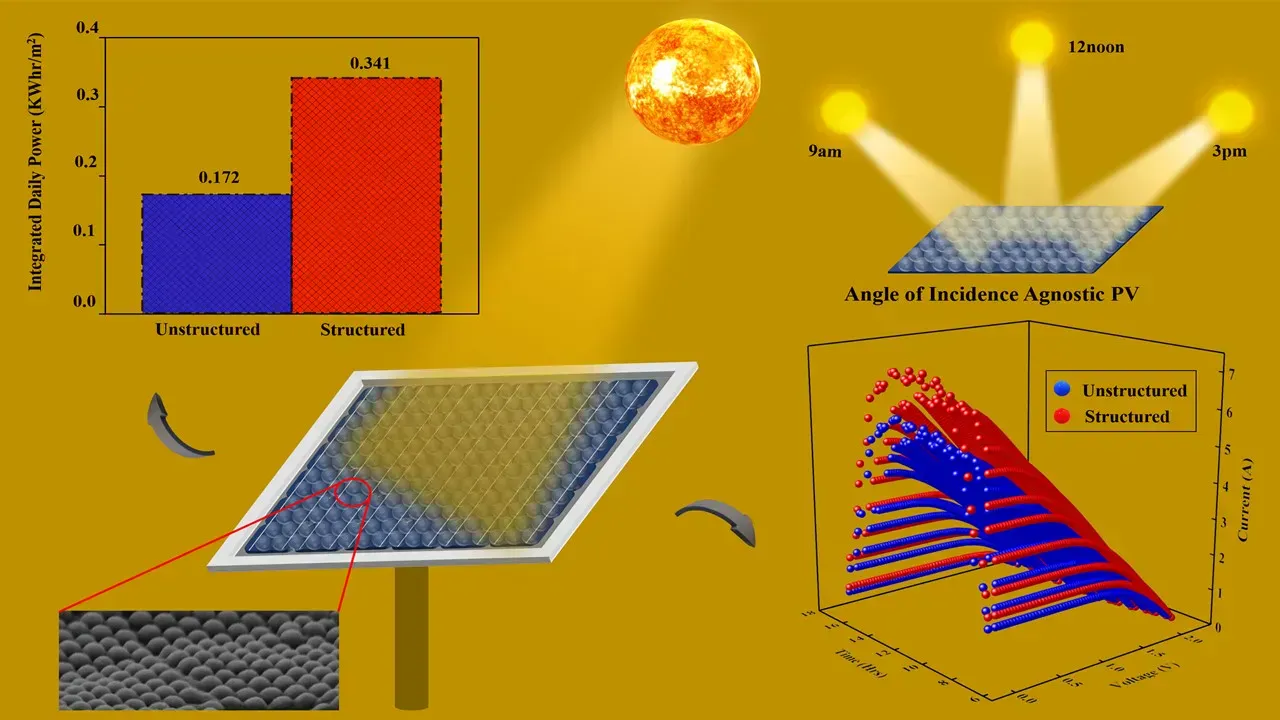
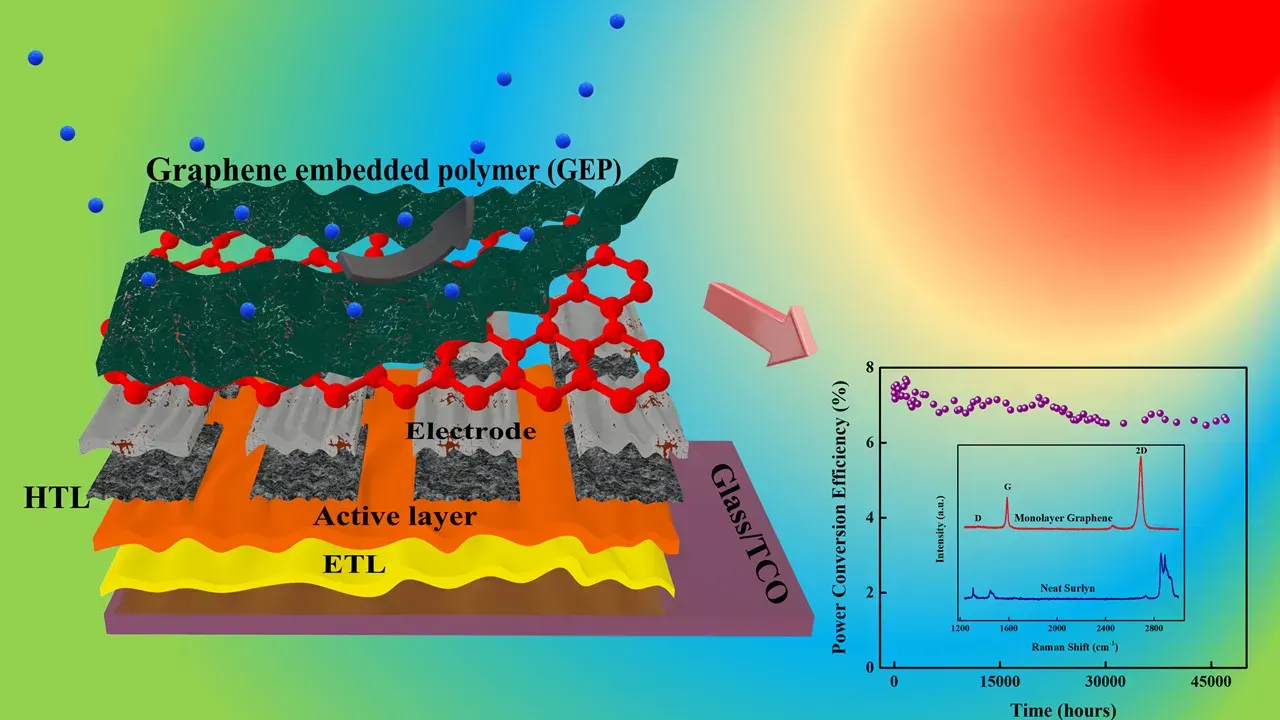
This theme covers nanostructured and hybrid device architectures - electrospinning, ternary blends, and non-lithographic nanostructuring for solar cells and field-effect transistors - together with packaging and stability work: ultra-low-permeability encapsulants, CRDS-based permeability testing, and failure analysis. This is the work that has demonstrated organic photovoltaics operating for more than 80,000 hours while retaining over 80% performance.
Environmental Materials
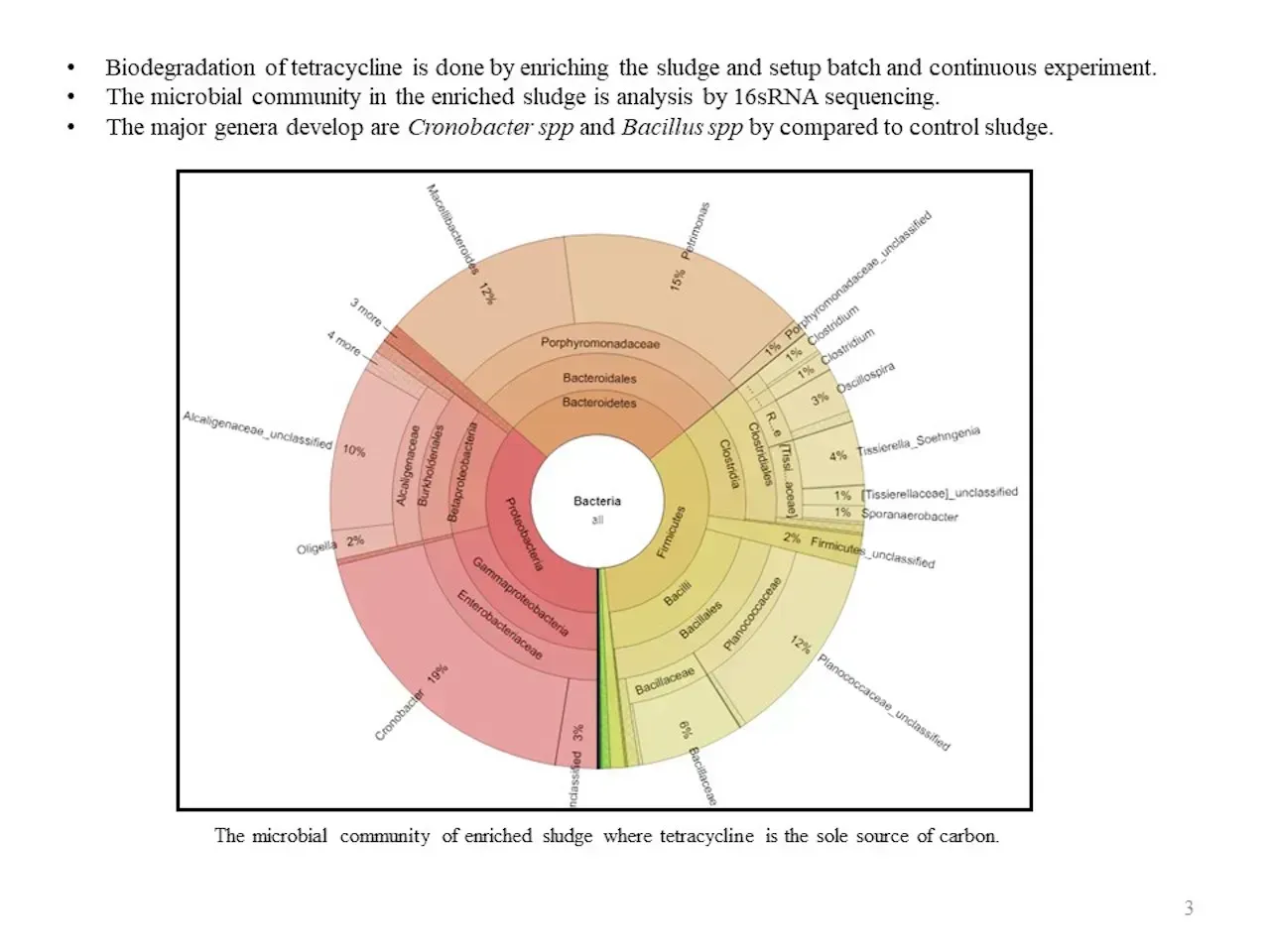
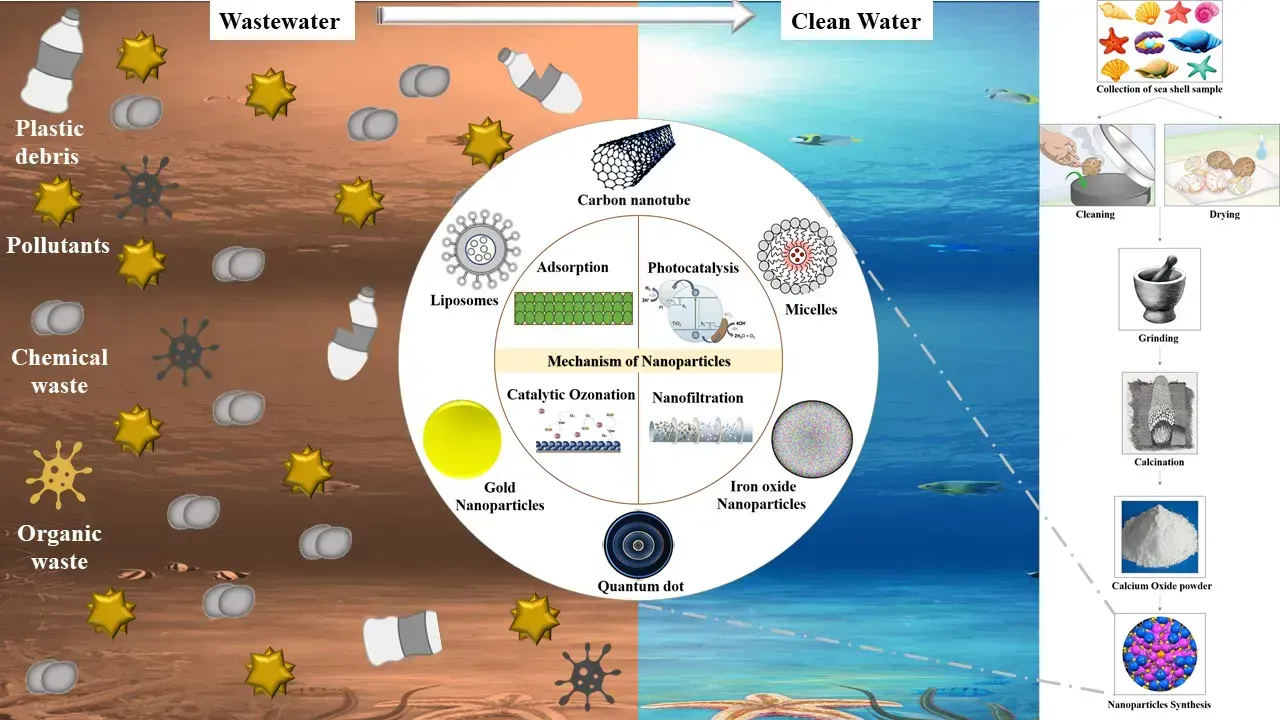
Sensing platforms are coupled with remediation technologies to close the detection-mitigation loop: fluorescence-tagged probes and biomimetic nanomaterials for microplastic and nanoplastic detection and capture, MOF-biochar hybrids and nanofibers for heavy-metal and PFAS adsorption, and hybrid nanostructures for the simultaneous sensing and breakdown of pesticides and antibiotics.
Our group at the Indian Institute of Science, Bengaluru, advances the science and engineering of organic electronics and functional materials, guided by the principle that fundamental molecular-scale understanding drives real-world technologies. We design molecules, study charge transport and exciton dynamics, and build devices that address energy, environment, and health challenges.
Molecular Design and Charge Transport
At the heart of our research is the rational design of bandgap-engineered molecules and conjugated polymers. We probe:
- Electronic structure tuning: donor-acceptor frameworks and hybrid composites
- Charge transport dynamics: exciton diffusion, polaron motion, trap-limited transport, and recombination
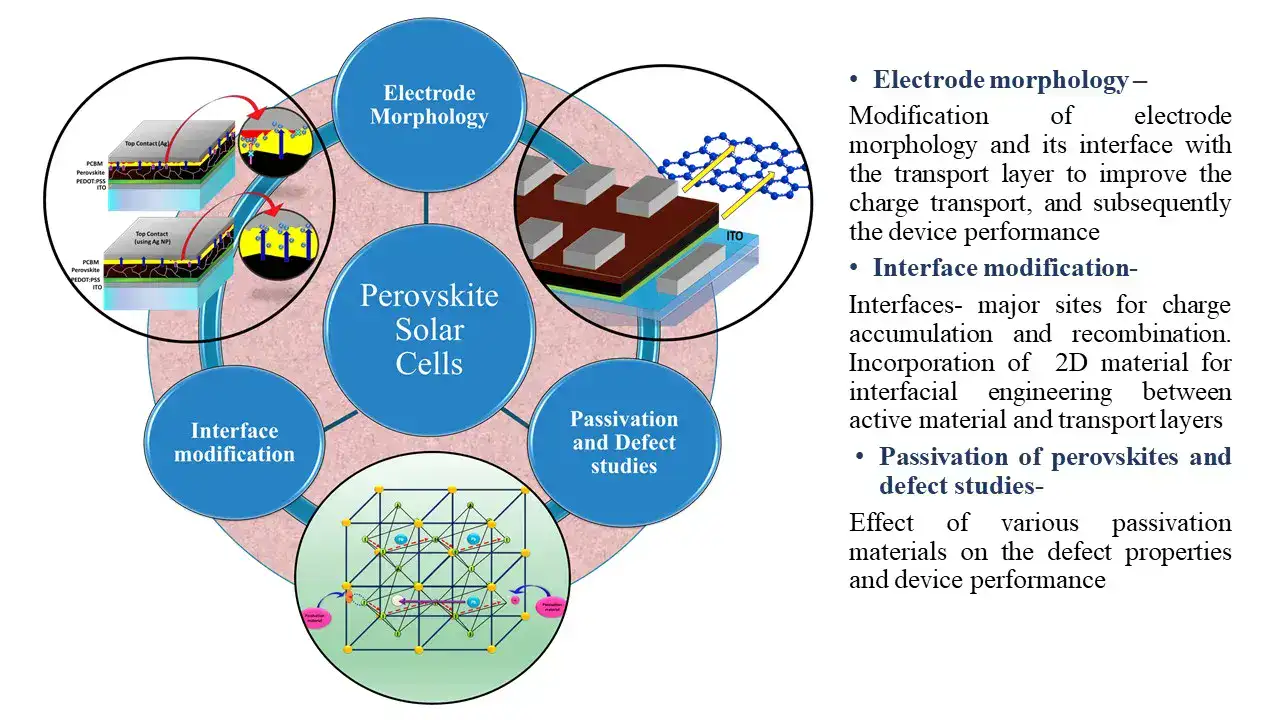
- Interface engineering: semiconductor-electrode boundaries
- Structure-property correlations: linking nanoscale ordering to macroscopic electronic behaviour
Sensors and One Health
We create sensors that use molecularly engineered receptors and nanostructures to translate recognition events into measurable charge or optical signals. Aligned with the One Health paradigm, our sensors protect human, animal, and environmental health. Applications include:
- VOCs: aldehydes, bisphenol A, dopamine, atrazine
- Toxic ions: arsenic, lead, mercury, cadmium, chromium
- Biomarkers and pathogens: E. coli, Bacillus cereus, thyroxine, tryptophan
- Emerging contaminants: pesticides, antibiotics, PFAS, microplastics
We are building real-time early warning systems for water, food, and air quality by embedding these systems in IoT-enabled platforms.
Environmental Remediation and One Health Integration
Our sensing platforms are coupled with remediation technologies to close the detection-mitigation loop:
- Microplastics and nanoplastics: fluorescence-tagged probes for detection; biomimetic nanomaterials for capture and degradation
- Heavy metals and PFAS: designed MOF-biochar hybrids and nanofibers for adsorption and removal
- Pesticides and antibiotics: hybrid nanostructures for simultaneous sensing and breakdown
Device Architectures
We investigate nanostructured and hybrid devices to translate molecular design into scalable technologies:
- Fabrication approaches: electrospinning, ternary blends, and non-lithographic nanostructuring for solar cells and FETs
- Charge transport mapping: spectroscopy and electrical probes
- Failure analysis: ageing studies for long-term performance insights
- Hybrid materials: organic-inorganic systems for high efficiency and durability
Packaging and Stability
We have pioneered:
- Encapsulants: ultra-low-permeability designs, including graphene monolayers
- Permeability testing: CRDS-based (Cavity Ring-Down Spectroscopy) methods setting new accuracy benchmarks
- Photovoltaic lifetime: demonstration of organic photovoltaics operating for more than 80,000 hours while retaining over 80% performance - among the most extended lifetimes worldwide
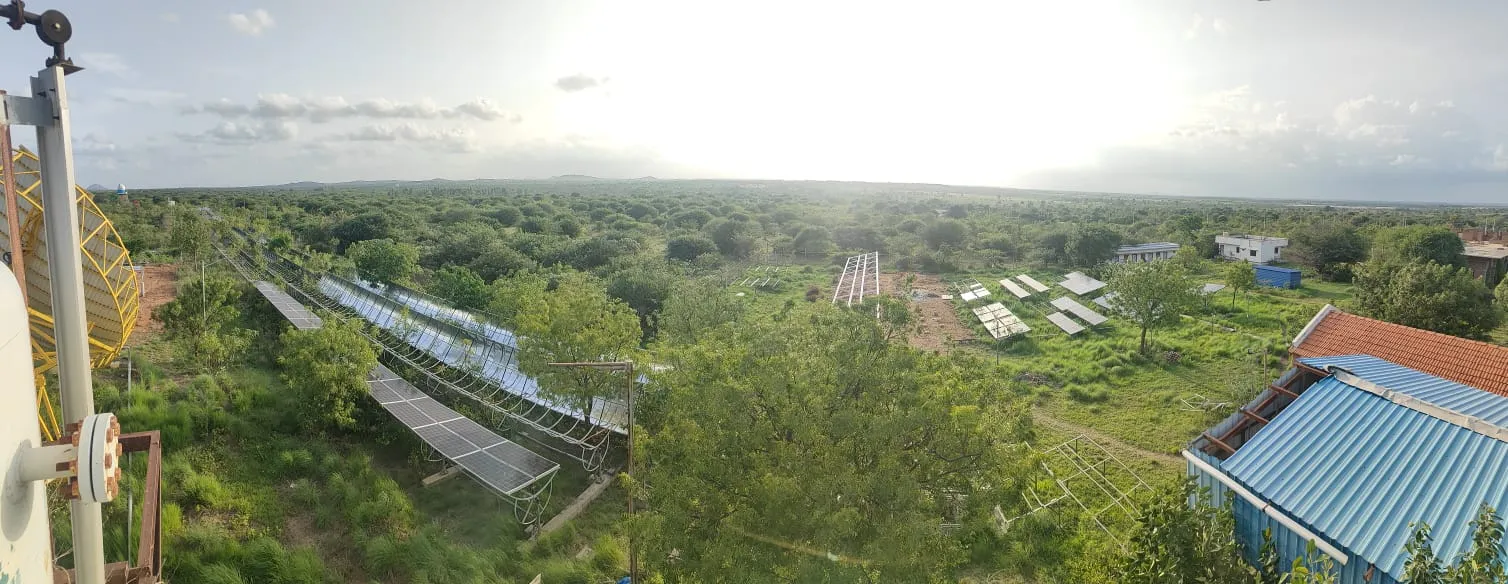
Solar PV Outdoor Reliability Testbed at Challakere
Complementing our lab-scale research, we operate a 22 kW solar PV outdoor reliability testbed at IISc's Challakere campus. This facility includes 116 modules across mono, poly, and thin-film technologies, dual-axis trackers, hybrid inverters, and advanced instrumentation. It enables:
- Reliability studies: long-term analysis under real Indian climatic conditions
- Technology evaluation: PV designs under stressors such as temperature, dust, humidity, UV, and wind
- Microgrid demonstration: battery integration for off-grid and hybrid applications
- Performance databases: independent datasets for industry, policymakers, and researchers
Technology Translation
Our research philosophy extends from molecules to market:
- Indriya Sensotech Pvt. Ltd.: IoT-enabled water sensors (National Jal Jeevan Mission awardee)
- ABX3 PV Pvt. Ltd.: large-area perovskite solar modules
- Envitran Smart Systems Pvt. Ltd.: IoT-enabled air purification
- Oxygen concentrator technology: deployed through 27+ manufacturers during the COVID-19 pandemic